
Betting explained
What Overround Is and How to Calculate It
The overround is the bookmaker’s margin, built into the odds before you place a bet. Add up what every price in a market implies and a fair market totals 100%. A real one totals more, and the difference is what the book expects to keep whatever the result. This page shows you how to measure it in about thirty seconds, and what it costs across 300 real prices we put a number on.
 By
By

What the overround is
Odds are a price, not a forecast. Every price a bookmaker puts up implies a chance of that outcome happening, and you find it by dividing one by the decimal odds. A price of 2.00 implies 50%. A price of 4.00 implies 25%.
Add the implied chances for every outcome of one market and you get a total. If the book were charging nothing that total would be exactly 100%, because one of the outcomes has to happen. It never is. A real market totals more, and the amount it overshoots 100% is the overround.
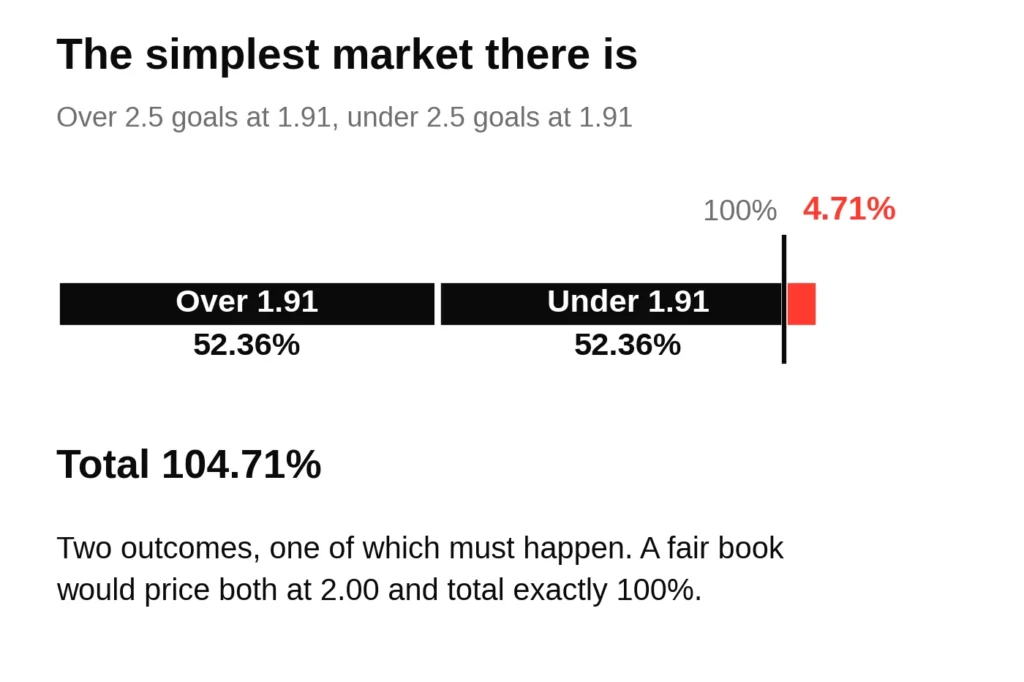
Why you pay it on every bet
That overshoot is not a fee taken from your winnings. It is inside every price on the board before you stake anything, so it applies to the bet you win and the bet you lose alike.
This is what makes it the most useful single number in betting. A tipster tells you what might happen. The overround tells you what the market costs you for finding out.
Work out the overround on any market
Four steps, no spreadsheet required. The calculator below does the same arithmetic if you would rather type the prices in.
-
Take the odds for every outcome of one market
For a match result that is three prices. For a two-way market such as over and under 2.5 goals, or an Asian handicap, it is two. Use decimal odds, and take them all from the same moment, because a market that has moved between quotes is not one market.
-
Convert each price to its implied chance
Divide one by the decimal odds. A price of 2.10 implies 0.476, or 47.6%. This is the chance the price is charging you for, not the chance the outcome actually happens.
-
Add the implied chances together
A market with no margin in it totals exactly 1.00, or 100%. Every real market totals more than that.
-
Subtract one
What is left is the overround. A total of 1.048 means 4.8%. That is the share of every pound staked into this market the book expects to keep, win or lose.
TOOL
Overround calculator
Type in the decimal odds showing for every outcome of one market. For a two-way market, leave the third box at zero.
Bookmaker margin 4.8% Prices add up to 104.8%
| Outcome | Fair odds | Chance implied |
|---|---|---|
| Home | 2.20 | 45.4% |
| Draw | 3.56 | 28.1% |
| Away | 3.77 | 26.5% |
- Expected cost per bet GBP0.46
- Expected cost per year GBP119.29
At these prices the bookmaker builds in a 4.8% margin. On a GBP10 bet that is worth about GBP0.46 to them on average — roughly GBP119.29 a year at 5 bets a week.
The calculator spreads the margin evenly across outcomes. Bookmakers rarely do. Most of the cut is loaded onto the less likely result, so a bet on a heavy favourite is usually better value than the headline margin suggests, and a bet on a long shot is usually worse.
What the overround costs you in pounds
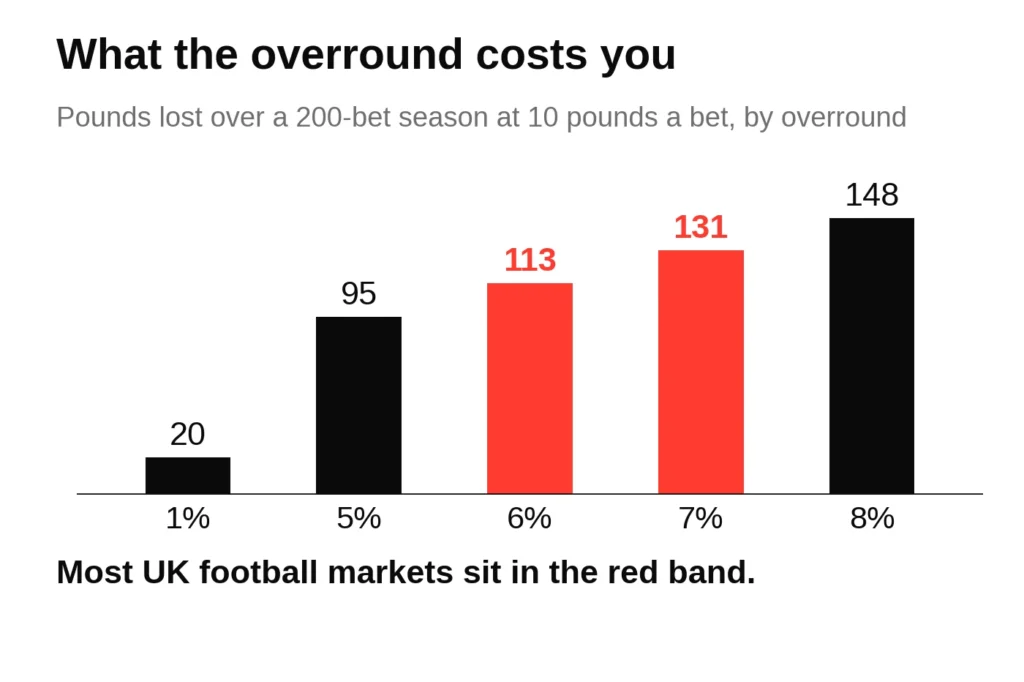
A percentage is easy to shrug at. The same number in pounds is harder to ignore. The cost of a market is the overround divided by one plus the overround, applied to your stake. At 6% that is 5.7p in every pound, or 57p on a ten pound bet, and you never see it leave your account because it was already inside the price you took.
Bet ten pounds twice a week for a year and you have staked about two thousand pounds. Here is what that costs at each level.
What a season costs at each level
| 1% overround | 9.9p a bet, about 20 pounds a season. Roughly what a betting exchange charges before commission. |
|---|---|
| 5% overround | 47.6p a bet, about 95 pounds a season. A sharp price on a mainstream market. |
| 6% overround | 56.6p a bet, about 113 pounds a season. The middle of the UK football market. |
| 7% overround | 65.4p a bet, about 131 pounds a season. A quarter of the prices we measured were this bad or worse. |
| 8% overround | 74.1p a bet, about 148 pounds a season. Common on minor competitions and on in-play prices. |
What the overround looks like on real markets
Almost nothing written about the overround publishes a number. We measured one.
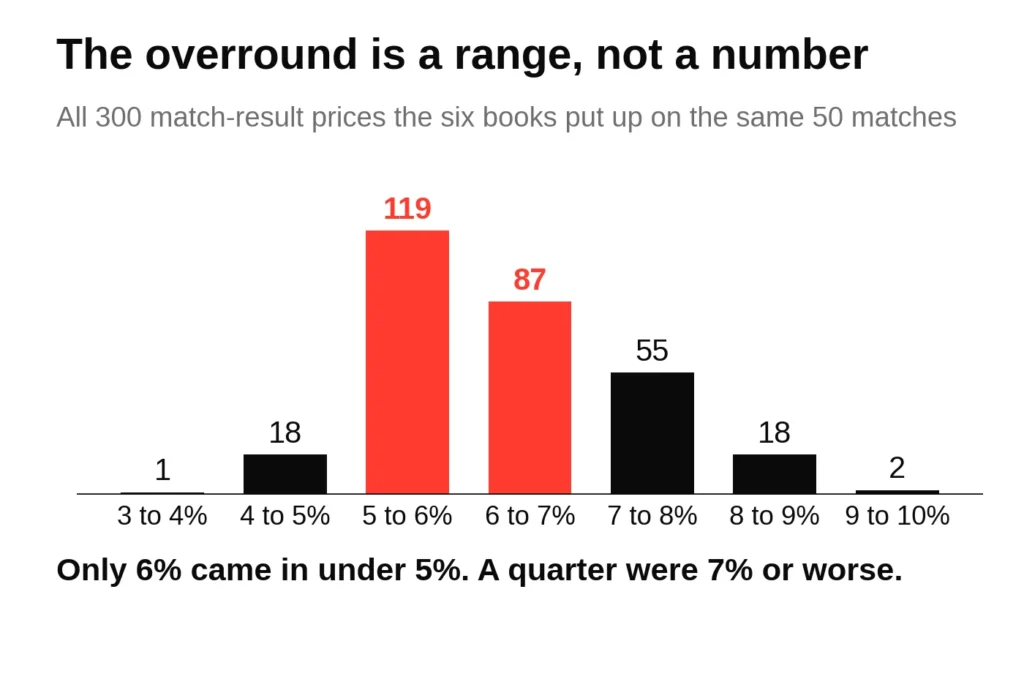
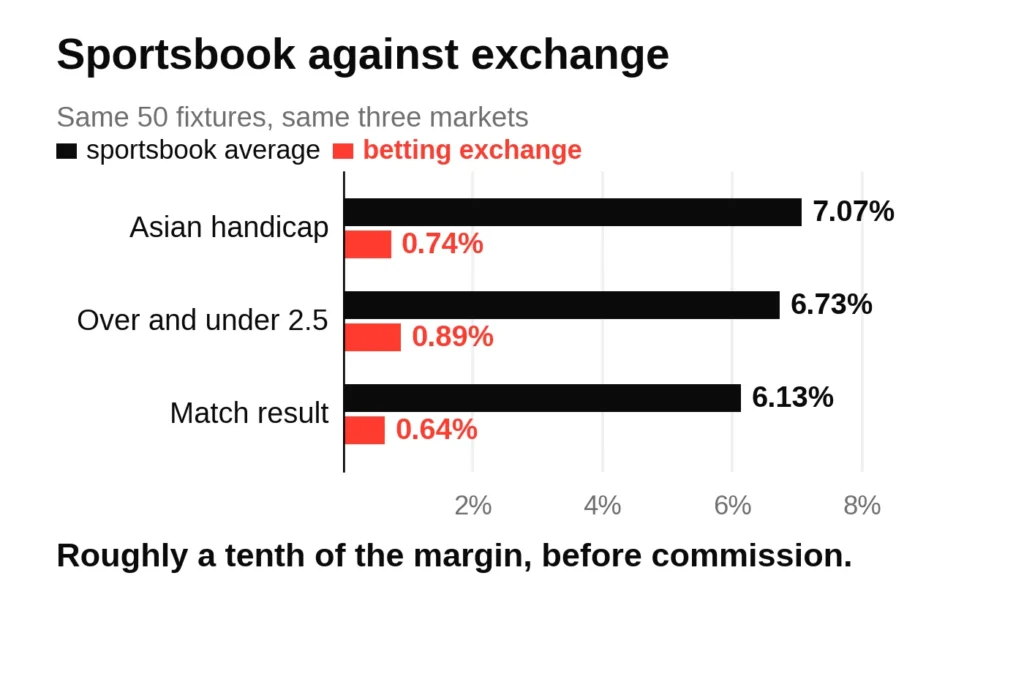
Across 50 Premier League fixtures played between 21 August and 20 September 2026 we took every price six major UK bookmakers put up on the match result, on over and under 2.5 goals and on the Asian handicap, and computed the margin on each. The underlying odds are published free by football-data.co.uk, so anyone can repeat it. Our football markets page walks through the same sample in detail.
Margin by market, across the market and at the keenest book
| Match result | 6.13% across the market, 5.55% at the keenest book |
|---|---|
| Over and under 2.5 goals | 6.73% across the market, 5.02% at the keenest book |
| Asian handicap | 7.07% across the market, 4.01% at the keenest book |
| Betting exchange, all three markets | 0.64% to 0.89%, with commission charged separately on winnings |
| Gap between the two columns | 0.58 points on the match result, 1.71 on goals, 3.06 on Asian handicap |
Why the same market has two different overrounds
Look again at that table and you will see every market carries two numbers. That is not a hedge, it is the most important thing on this page. The market figure is what you pay betting with whoever you happen to hold an account with. The keenest figure is what the single sharpest book charged on the same fixtures.
On the match result those two sit half a point apart. On the Asian handicap, three points apart. So an overround figure is close to meaningless unless you say which of the two it is. Asian handicap is widely called the cheapest market in football, and at the right book it is. Averaged across the market it was the dearest of the three we measured.
How the overround multiplies on an accumulator
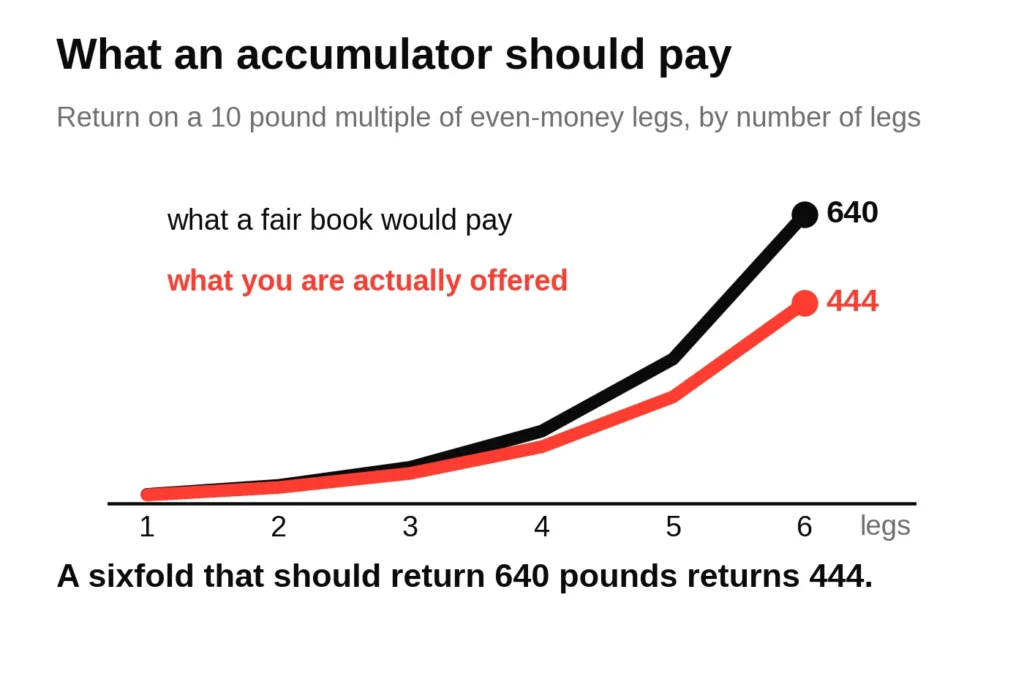
Every leg of a multiple carries its own overround, and multiplying the odds multiplies the cut along with them. At the 6.28% average we measured, a single bet costs about 5.9% of your stake in expectation. A fourfold costs about 21.6%, because you pay that cut four times over. An eightfold costs nearly 39%.
That is the arithmetic, and it does not make multiples a mistake. It means the price of the fun is far higher than the headline number suggests, and that comparing each leg across books matters more on an accumulator than on any single bet.
Three ways to pay less overround
The overround is not a tax rate. It is a price, it varies by market and by book, and three things move it. All three are in your hands and none of them requires being any good at picking winners, which is what makes them the cheapest edge available to an ordinary punter.
Ranked by what they are worth
Measured on the same sample, in order of how much each one saves.
-
Take the best price on every outcome
This is worth more than the other two combined. Betting one book at the market average cost 6.13% across our sample. Taking the best available price on each outcome from the six cost 0.95%, a saving of more than five percentage points. It needs more than one account and about ten seconds of checking. Overround Desk ranks books on measured price first for exactly this reason.
-
Use an exchange where the liquidity is there
On the same fixtures and the same markets, exchange prices carried a margin of 0.64% to 0.89%, roughly a tenth of what the sportsbooks charged. Commission on net winnings closes part of that gap, and liquidity outside the main competitions can be thin, but on a well-backed market the difference in raw price is not close.
-
Take a price concession where one is offered
A best odds guaranteed promise pays you the larger of the price you took and the starting price, which lowers your effective overround without you doing anything at all. It is worth most on markets that move a long way before the off.
When a low overround comes with a catch
There is a reason the advice above is not universal. A bookmaker that prices keenest attracts the punters who compare prices, and those are the punters it least wants. The usual response is not to refuse the bet but to cut what you may stake, quietly, until a bet that used to go on for fifty pounds goes on for two. Nothing is closed and nothing is explained.
That is concentrated among the books that price tightest, which puts anyone acting on this page in an awkward spot. The more consistently you take the best price, the faster your stake gets trimmed. We go through what it looks like, and which books do it least, on the page about accounts that get limited.

Overround questions answered
On a football match result, anything at or below about 5% is sharp for a UK sportsbook. Our sample averaged 6.28%, and a quarter of the prices were 7% or worse. An exchange prices the same market under 1% before commission.
Close enough for practical purposes, though they are calculated differently. House edge usually describes the long-run expected loss as a share of stake. The overround describes how far a market’s prices exceed 100%. At a 6% overround the expected loss is about 5.7% of stake, so the two sit near each other without being identical.
In-play prices carry more margin than pre-match ones, because the book is pricing faster and with less information. How much more varies by sport and by how quickly the market moves. The arithmetic does not change. Our page on betting odds explained covers the formats.
Across one book, almost never. Across several, yes. Take the best over price from one book and the best under price from another and the two can total under 100%. In our sample the best available over and under 2.5 prices did exactly that. That is an arbitrage, and books restrict accounts that take them repeatedly.
Not necessarily. The calculator spreads the margin evenly across outcomes, but bookmakers load most of it onto the less likely result. A book with a middling overround can still hold the best price on the favourite. Compare the specific price you want, not only the market total.
Two makes a real difference and three captures most of what is available. The gain from each extra account falls away quickly after that, and more accounts means more exposure to having a stake cut.
Yes, but a much smaller one, and it comes from the gap between the back and lay prices rather than from a margin built into the odds. On the markets we measured it ran from 0.64% to 0.89%. Commission on net winnings is charged separately and is the main cost.
No. It is lowest on the most heavily traded markets, which in the UK means football match odds and the main horse racing win markets, and highest on minor competitions, novelty markets and in-play prices on sports the book has less data on.